If you’ve ever asked yourself, “What PSI should bike tires be?”, you’re not alone. Tire pressure is one of the easiest things to adjust, but it makes a huge difference in how your bike feels. Get it right, and you’ll ride smoother, faster, and safer. Get it wrong, and you’ll risk flats, blowouts, or just an uncomfortable ride.
I’ve made all the mistakes, pumping my road bike tires rock-hard until every bump rattled my bones, and riding my mountain bike so soft that I nearly pinch-flatted on a root. That’s why I put together this guide. It’s simple, clear, and full of tips you can use right away.
The Hybrid Sweet Spot: Comfort Meets Speed
If you’re riding a hybrid, you’re likely dealing with a hybrid bike tire pressure range that is quite broad. Generally, a hybrid bicycle tire pressure should sit between 50 and 70 psi.
When I’m helping a friend tune their hybrid bike psi, I tell them to start at 60. If the ride feels too bumpy, drop the psi for hybrid bike tires by 5. If it feels “squishy” or slow, add a little more bike tire psi. The goal for hybrid tyre pressure is to have enough cushion to absorb cracks in the sidewalk but enough firmness to stay efficient.
I remember the very first time I took my bike out for a long distance ride. I had pumped the tires until they were rock-hard, thinking “harder equals faster.” Twenty miles later, my hands were numb from the vibration and I felt every single pebble on the road. That was my introduction to the science of air; I quickly learned that the question isn’t just “how much air,” but what psi should bike tires be for the actual terrain you’re riding.
Finding the optimal bike tire pressure is a bit like seasoning food—it’s personal, but there are some rules you can’t break. If you’ve been searching for how much psi for a bike tire, I’m going to share the “cheat sheet” I’ve developed over thousands of miles of road and trail riding.
Road Bike Pressure: The Myth of 120 PSI
For the roadies out there, the old-school advice was to max out the road bike tire psi. Modern testing has proven that road bike tyre pressure psi should actually be lower than we thought.
Unless you’re on a track, psi road bike tires usually perform best between 80 and 100 psi. If you go too high, your tire bounces off the road surface instead of rolling over it, which actually wastes energy. When I’m asked what psi for road bike tires is best, I always factor in rider weight. A lighter rider needs a lower psi for road bike tires than someone heavier.
| Bike Type | Recommended PSI Bike Tyre Range | Ideal Terrain |
| Road Bike | 80 – 110 PSI | Smooth Pavement |
| Hybrid / City Bike | 50 – 70 PSI | Commuting / Paved Paths |
| Mountain Bike (MTB) | 22 – 35 PSI | Dirt / Roots / Rocks |
| Surron / Electric | 20 – 30 PSI | Off-road / Trail |
How to Find Your Recommended PSI
If you are looking at your wheel and wondering what pressure should bike tires be, look at the sidewall of the tire itself. Every manufacturer prints a recommended psi bike tires range right there.
However, don’t just blindly follow the “max” number. For example, a bicycle tyre psi might say “Max 85 PSI.” That doesn’t mean you should be at 85. That is the safety limit. Most bicycle tire pressure experts (myself included) suggest staying about 10-15% below that max for a smoother ride.
Why Weight and Width Matter
When calculating how much psi for a bicycle tire, you have to consider your own weight. If you’re a heavier rider, your bicycle tires psi needs to be higher to prevent “pinch flats” (where the tube gets pinched against the rim).
Also, consider the width. A wider city bike tire psi can be much lower than a skinny racing tire. Here’s a niche tip: your bike wheel psi in the rear tire should usually be about 5% higher than the front, because that’s where most of your body weight sits!
- What psi should my bike tyres be for rain? Drop them by 5-10 PSI to get a bigger “contact patch” and better grip.
- How much air does a bicycle tire need for storage? If you aren’t riding, keep them at normal bike tire pressure so the sidewalls don’t crack.
- What is the psi for a bicycle tire on gravel? Lower is better—usually around 35-45 PSI.
Whether you are looking for proper bicycle tire pressure for a triathlon or just wondering what psi bike tires should have for a trip to the grocery store, remember that air is free. Experiment!
Check your psi on bike tires every single week. Bicycle tubes are porous and will naturally lose a few psi for bike tires over a few days. Don’t be the person riding on 20 PSI when you should be at 60; it’s the fastest way to ruin a good bicycle wheel psi and tire.
Understanding Bike Tire Pressure: What Does PSI Mean?
PSI stands for pounds per square inch. It’s a unit that measures how much air is pressing against the inside of your tire walls.
- Low PSI → more comfort and grip, but higher risk of pinch flats.
- High PSI → less rolling resistance and faster speed, but harsher ride and less traction.
Every tire has a recommended PSI range printed on the sidewall. For example:
- Road bike: 80–130 PSI
- Mountain bike: 20–35 PSI
- Gravel bike: 20–45 PSI
- Hybrid/commuter: 50–70 PSI
- Kids’ bike: 7–40 PSI (depending on wheel size)
That range isn’t just random, it’s based on tire size, intended use, and rider weight.
Why Proper Bike Tire PSI Matters
The right bike tire pressure affects speed, safety, comfort, and tire life:
- Performance: Too soft? You waste energy pedaling. Too hard? You bounce around.
- Safety: Underinflation causes pinch flats. Overinflation risks blowouts, especially on hot days.
- Comfort: Lower PSI cushions bumps. Higher PSI makes rough roads feel rougher.
- Traction: Lower PSI grips better on gravel or dirt. Higher PSI rolls faster on smooth pavement.
Think of it like Goldilocks, you want it just right.
Recommended PSI for Bike Tires by Type
Road Bike Tire Pressure
Road bikes roll on narrow tires designed for speed.
- 23–28mm tires → 80–130 PSI
- 30–32mm tires → 50–90 PSI
Here’s a quick road bike tire pressure chart (PSI by rider weight):
| Rider Weight (lbs) | 23mm | 25mm | 28mm | 30mm | 32mm |
|---|---|---|---|---|---|
| 100–120 | 70–74 | 65–69 | 60–64 | 55–59 | 50–54 |
| 130–150 | 76–80 | 71–75 | 66–70 | 61–65 | 56–60 |
| 160–180 | 82–86 | 77–81 | 72–76 | 67–71 | 62–66 |
| 190–210 | 88–92 | 83–87 | 78–82 | 73–77 | 68–72 |
| 220–250 | 94–100 | 89–95 | 84–90 | 79–85 | 74–80 |
Pro tip: Pump your rear tire 2–4 PSI higher since it carries more weight.
Mountain Bike Tire Pressure
MTB tires need grip and shock absorption.
- 26-inch tires → 20–30 PSI
- 29-inch tires → 18–30 PSI
- Tubeless tires → run 3–5 PSI lower safely.
Lower pressure = better traction on roots and rocks.
Higher pressure = faster rolling on hard-packed trails or pavement.
Gravel Bike Tire Pressure
Gravel riding blends road and off-road.
- 30–35mm tires → 25–45 PSI
- 40–50mm tires → 20–30 PSI
Here’s a quick gravel bike tire PSI chart:
| Rider Weight (lbs) | 35-38mm Tires | 38-42mm Tires | 42-45mm Tires | 47-50mm Tires |
|---|---|---|---|---|
| 100-120 | 35-37 | 30-32 | 25-27 | 20-22 |
| 130-150 | 38-40 | 33-35 | 28-30 | 23-25 |
| 160-180 | 41-43 | 36-38 | 31-33 | 26-28 |
| 190-210 | 44-46 | 39-41 | 34-36 | 29-31 |
| 220+ | 47+ | 42+ | 37+ | 32+ |
On loose gravel, go lower for control. On pavement, go higher for speed.
Hybrid & Commuter Bike Tire Pressure
- Medium-width tires → 50–70 PSI
Perfect for daily rides across city streets, bike paths, and light trails.
Kids’ Bike Tire Pressure
- 12-inch → 7–20 PSI
- 16–20-inch → 20–40 PSI
- 24-inch → 20–40 PSI
Keep it on the lower end for safety and handling.

Bike Tire PSI Quick Chart
For a handy overview, use this general bike tire pressure chart compiled from expert sources. Remember, these are starting points, fine-tune based on your setup.
| Bike Type | Tire Size/Width | PSI Range |
|---|---|---|
| Road Bike | 19–23mm | 115–120 |
| Road Bike | 24–28mm | 90–115 |
| Road Bike | 30–32mm | 80–100 |
| Mountain Bike | 26-inch | 20–30 |
| Mountain Bike | 29-inch | 18–30 |
| Gravel Bike | 30–40mm | 25–35 |
| Gravel Bike | 40–50mm | 20–30 |
| Hybrid/Commuter | Medium | 50–70 |
| Kids’ Bike | 12–16-inch | 7–35 |
| Kids’ Bike | 20–24-inch | 20–40 |
This bike tire PSI chart factors in common scenarios, but tools like online calculators can personalize it further.
Factors That Affect Bike Tire PSI
Several variables influence what PSI your bike tires should be. Here’s how to account for them:
- Rider weight & load → Heavier riders need 3–5 PSI more.
- Tire width → Wider tires = lower PSI possible.
- Tubeless vs tubed → Tubeless allows lower PSI safely.
- Terrain → Smooth = higher PSI. Rough = lower PSI.
- Temperature → Cold lowers PSI. Heat can increase it.
- Rim width → Wider rims stabilize wider tires at lower PSI.
Rider Weight and Load
Heavier riders need higher bike tire pressure to support the extra weight, add about 3-5 PSI if you’re over 180 lbs. Rear tires often carry more load, so inflate them 2-4 PSI higher than the front. Total system weight (you + bike + gear) is key for precise calculations.
Tire Width and Type
Wider tires can run lower PSI for comfort, while narrow ones need more for efficiency. Tubeless tires allow 3-5 PSI less than tubed ones, reducing puncture risk.
Terrain and Riding Conditions
Smooth roads? Go higher in the range. Rough trails or gravel? Drop the PSI for better grip. Temperature matters too, cold weather drops pressure, so check before winter rides.
Rim Width and Wheel Type
Internal rim width affects how the tire sits. For example, 21mm rims with 25-27mm tires on smooth pavement might recommend 80-100 PSI for lighter riders.
How to Check and Set PSI
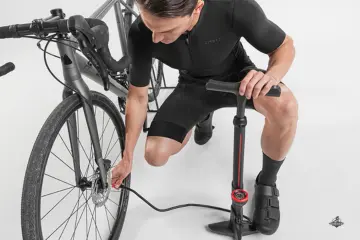
Wondering how to tell if your bike tires have the right air? Start by locating the recommended range on the sidewall. Use a floor pump with a gauge or a digital one for accuracy.
- Find the sidewall range on your tire.
- Use a floor pump with a gauge (digital is most accurate).
- Set rear tire 2–4 PSI higher than the front.
- Check weekly, bike tires naturally lose 1–2 PSI over time.
- Quick test: Press with your thumb. Firm, but slight give = good.
Use either Presta valves (common on road & MTB) or Schrader valves (common on hybrids & kids’ bikes).
Common Tire Pressure Mistakes
- Overinflation → Harsh ride, risk of blowouts.
- Underinflation → Pinch flats, sluggish handling.
- Ignoring conditions → Cold mornings or hot descents change PSI.
- One-size-fits-all → Your PSI may differ from a friend’s, even with the same bike.
Final Thoughts: Dial in Your PSI for the Best Ride
The answer to “What PSI should bike tires be?” depends on your bike type, weight, and riding style. Start with the printed sidewall range. Use the charts above as a guide. Then adjust until the bike feels right for you.
Getting tire pressure dialed in is like tuning an instrument, it makes everything work better. Your ride becomes smoother, safer, and more fun.
So grab a pump, check your PSI, and enjoy the road, trail, or gravel path ahead.
FAQs
No, 40 PSI is not too high for bike tires. It is a good pressure for many city and mountain bike tires. It is too low for a road bike tire.
A bike tire is overinflated if it feels very hard. The tire will not give at all when you push on it. The tire may also look round like a ball. It is best to use a gauge.
No, 90 PSI is not too high for some bike tires. It is a good pressure for road bike tires. It would be too high for a mountain bike tire.
80 PSI is a good pressure for some bike tires. It is a good number for many road bike tires. It would be too high for a city or mountain bike.
A higher PSI is not always better for a bike. It can make the ride rough. A higher PSI is good for speed on smooth roads. A lower PSI is better for comfort.
A good PSI for bike tires is a mix of things. It depends on your weight and your bike. A number from 60 to 80 PSI is good for many riders.
Yes, 60 PSI is good for many bike tires. It is a good pressure for a city or hybrid bike. It is a bit low for a road bike. Not only that, but it is too high for a fat bike.
Yes, tire pressure affects speed. A higher tire pressure helps you go faster on smooth roads. It makes the ride less smooth. Lower pressure is better for a rough path.
Your motorcycle tire PSI should be what the maker says. You can find this in your motorcycle’s book. The front and back tires may have different numbers.
No, the front and rear tires should not have the same PSI. The rear tire holds more of your weight. It should have a higher PSI. The front tire can have a bit less air.
Aim for once a week or before every ride, as tires naturally lose air over time.
Yes, but carefully, car compressors can overinflate quickly. Use a gauge-equipped bike pump for precision.
Fall back on general recommendations: 80-130 PSI for road, 30-50 for mountain, etc., and test for feel.
Not always, too low risks of rim damage. Balance it with your terrain for the sweet spot.
PSI is common in the US; BAR (about 14.5 PSI per BAR) is used elsewhere. Convert as needed for international guides.

Ehatasamul Alom is a dedicated road hybrid bikes expert. With over 15 years of experience, he helps people find the perfect ride. He began his journey as a bike mechanic. He learned the ins and outs of every bike.
Ehatasamul Alom holds a Master's degree in Mechanical Engineering from a Brown University (Providence US 02912), where he specialized in material science and bicycle kinematics. His master's thesis focused on optimizing frame geometry for road hybrid bikes to improve rider comfort and efficiency.
Ehatasamul has an extensive professional background. He spent 10 years (2010-2020) as a Senior Bike Designer at "Urban Cycles," a leading bicycle manufacturer. In this role, he led the development of several award-winning road hybrid bikes, which are known for their durability and performance. He later served (2020-2024) as the Head of Product Development at "Gear Up," a company specializing in high-end cycling components. There, he developed innovative parts and accessories specifically for road hybrid bikes.
Over the years, Ehatasamul has become an authority on Roadhybridbikes. He understands their design and function. His work focuses on making bikes easy to use. Ehatasamul believes everyone should enjoy cycling. He writes guides that are simple to read. His passion for road hybrid bikes is clear. His goal is to share his knowledge with everyone. He wants to see more people on two wheels. His advice is always practical and easy to follow.
- Ehatasamul Alom

- Ehatasamul Alom
- Ehatasamul Alom

- Ehatasamul Alom