Hybrid bikes are built for exactly the riding many North Texas commuters want: paved trails, short city hops and an upright position that doesn’t punish your back. In Plano that might mean the Chisholm Trail or the Bluebonnet Trail on a Saturday, or driving partway to work and pedaling the last stretch to an office near Legacy West. Sooner or later, the bike rides on the car. Here’s how to pick a rack, use it safely and understand which policy pays if something goes wrong.
The three main rack types
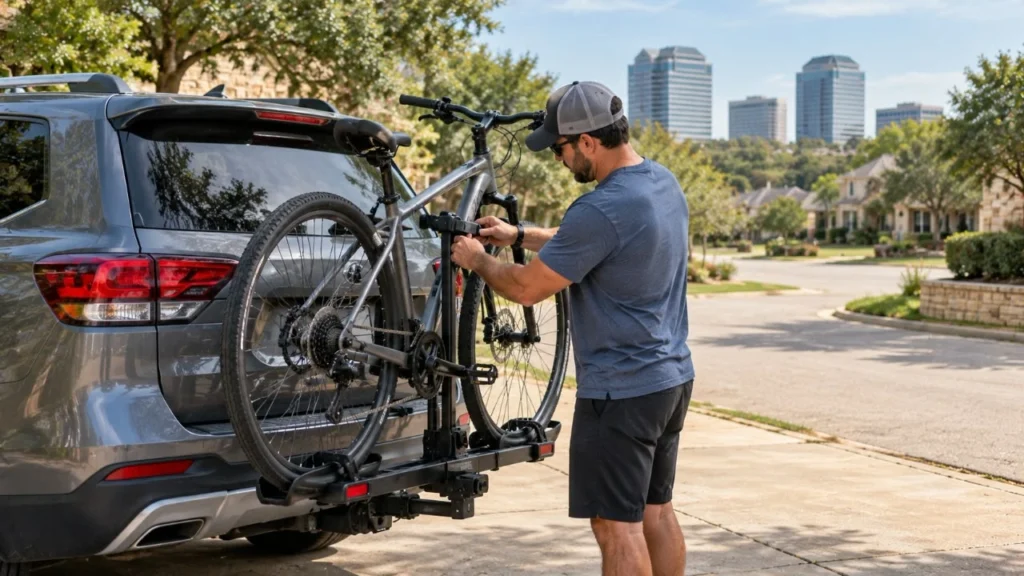
Hitch-mounted racks
These slide into a trailer hitch receiver, usually 1.25 or 2 inches, and hold bikes on trays or hanging arms.
- Pros: Loading happens at waist height, nothing touches your paint, and tray styles grip the bike by its wheels, which suits hybrid frames with sloping or oversized tubes.
- Cons: You need a hitch, the car gets longer (watch the back wall in tight parking garages), and the rack can block your plate or lights.
- Best for: Frequent use, heavier bikes and e-bike hybrids.
Roof racks
Crossbars on the roof hold bikes upright in fork or wheel mounts.
- Pros: The back of the car stays clear, they fit almost any car with roof rails, and they leave room for other gear.
- Cons: Lifting a heavy hybrid overhead isn’t easy, they add wind noise and drag, and drivers have a well-known habit of forgetting the bike is up there before pulling into a garage.
- Best for: Occasional trips and lighter bikes.
Trunk-mounted racks
Straps and padded arms hook onto the trunk lid or hatch.
- Pros: Inexpensive, compact to store, no hitch needed.
- Cons: They can scuff paint if installed carelessly, hold fewer bikes, and are less secure on long highway runs. Many don’t work with rear spoilers.
- Best for: Short, occasional drives.
Matching the rack to the bike
Hybrids vary more than road bikes do. A few fit questions to settle before you buy:
- Weight. Check the rack’s per-bike weight limit, especially for e-bike hybrids. Many roof racks can’t carry them.
- Frame shape. Step-through and sloping top tubes often don’t sit well on hanging-arm racks. A tray rack or a top-tube adapter bar solves that.
- Tire width. Hybrids often run wider tires than road bikes. Make sure the trays or wheel cradles accept them.
- Fenders and racks. Commuter hybrids with fenders, panniers or a rear cargo rack may need a tray style that clamps the frame or front wheel instead.
Safety checks before you pull out
- Double-check every strap and clamp. Highway speeds and gusty crosswinds on open stretches of the Dallas North Tollway and SH-121 put real stress on racks.
- Remove loose accessories, such as bottles, bags, lights and pumps, before driving.
- Keep plates and lights visible. If the rack hides them, add a light board or plate relocation kit.
- Lock the bike to the rack and the rack to the car when you stop for lunch or run into a store.
- Mind your height. Stick a reminder on the dash or garage door opener if you use a roof rack.
Riding safety matters as much as racking safety. According to NHTSA data published on Traffic Safety Marketing, 1,103 bicyclists were killed in traffic crashes in the United States in 2024, and an estimated 52,887 were injured. If your commute ends with a ride from a park-and-ride lot, wear a helmet that fits, run lights front and rear even in daytime, and choose trail connections over arterial roads where you can.
Coverage questions most cyclists never ask
A bike rack sits where auto insurance and homeowners or renters insurance meet, and the lines aren’t always obvious.
If the rack damages your car. A strap that scratches paint over time is usually treated as wear and tear, not a covered loss. Damage from a collision, such as backing into a pole with a hitch rack attached, may fall under collision coverage, subject to your deductible.
If the bike is damaged in a crash. Personal property riding on your car often isn’t covered by auto insurance. Many homeowners and renters policies cover bikes away from home, but the deductible may be close to what the bike is worth. Riders with expensive bikes sometimes buy separate bicycle coverage.
If the bike falls off and hits another car. Damage your loose cargo causes to someone else’s vehicle or property generally falls under your auto liability coverage.
Does a rack raise your premium? A removable rack generally isn’t treated like a permanent modification, but permanent changes, such as a newly installed hitch or wiring harness, are worth mentioning to your insurer. This explainer on whether add-ons like racks change your premium covers which changes insurers usually care about.
A Plano example
Consider a hypothetical commuter we’ll call Priya, who lives in west Plano and works near Legacy West. Three days a week she drives to a park-and-ride lot, unloads her hybrid from a hitch rack and rides the rest of the way on trail and bike lane. One morning a strap she hadn’t fully tightened worked loose on the tollway. The bike slid sideways but stayed attached, and nobody was hurt.
The scare sent her back to her paperwork. She learned her auto liability coverage would have applied if the bike had hit another car, but the bike itself would have been a claim on her renters policy, with a deductible close to the bike’s value. She now does a two-minute strap check before every drive, locks the bike to the rack, and reviewed her liability limits when she compared quotes for car insurance across Texas.
Other ways to carry a bike in Plano
A rack isn’t the only option. DART light rail stations at Downtown Plano and Parker Road give bike commuters a car-free link toward Richardson and Dallas, and DART allows bicycles on trains, subject to its posted rules and space on board. A folding hybrid can ride in a trunk with the seats down. Some employers around Legacy and the Shops at Legacy offer secure bike rooms, which can cut out the car portion entirely on good-weather days.
A two-minute rack routine
Before every drive: shake each bike hard at the saddle to check for movement, confirm every strap end is tucked so it can’t flap and fray, make sure the plate and brake lights are visible, and lock the rack. After every drive in rain, wipe down the clamps and hitch pin so they don’t seize. Once a month, check the rack’s bolts and the hitch pin clip. It takes less time than pumping your tires, and it’s the habit that keeps the bike on the car.

Ehatasamul Alom is a dedicated road hybrid bikes expert. With over 15 years of experience, he helps people find the perfect ride. He began his journey as a bike mechanic. He learned the ins and outs of every bike.
Ehatasamul Alom holds a Master's degree in Mechanical Engineering from a Brown University (Providence US 02912), where he specialized in material science and bicycle kinematics. His master's thesis focused on optimizing frame geometry for road hybrid bikes to improve rider comfort and efficiency.
Ehatasamul has an extensive professional background. He spent 10 years (2010-2020) as a Senior Bike Designer at "Urban Cycles," a leading bicycle manufacturer. In this role, he led the development of several award-winning road hybrid bikes, which are known for their durability and performance. He later served (2020-2024) as the Head of Product Development at "Gear Up," a company specializing in high-end cycling components. There, he developed innovative parts and accessories specifically for road hybrid bikes.
Over the years, Ehatasamul has become an authority on Roadhybridbikes. He understands their design and function. His work focuses on making bikes easy to use. Ehatasamul believes everyone should enjoy cycling. He writes guides that are simple to read. His passion for road hybrid bikes is clear. His goal is to share his knowledge with everyone. He wants to see more people on two wheels. His advice is always practical and easy to follow.
- Ehatasamul Alom

- Ehatasamul Alom

- Ehatasamul Alom
- Ehatasamul Alom