Two mini bikes can both have a 99cc engine and still deliver very different ownership experiences. That is because engine displacement tells you only one part of the story. It does not tell you whether the tires match your terrain, whether replacement parts are available, whether the frame leaves room for future upgrades or whether the bike actually fits an adult rider.
For most first-time buyers, the best 99cc mini bike is not automatically the cheapest one—or the one with the longest feature list.
It is the bike that matches where you ride, how much work you want to do after purchase and whether you plan to keep it stock or modify it later.
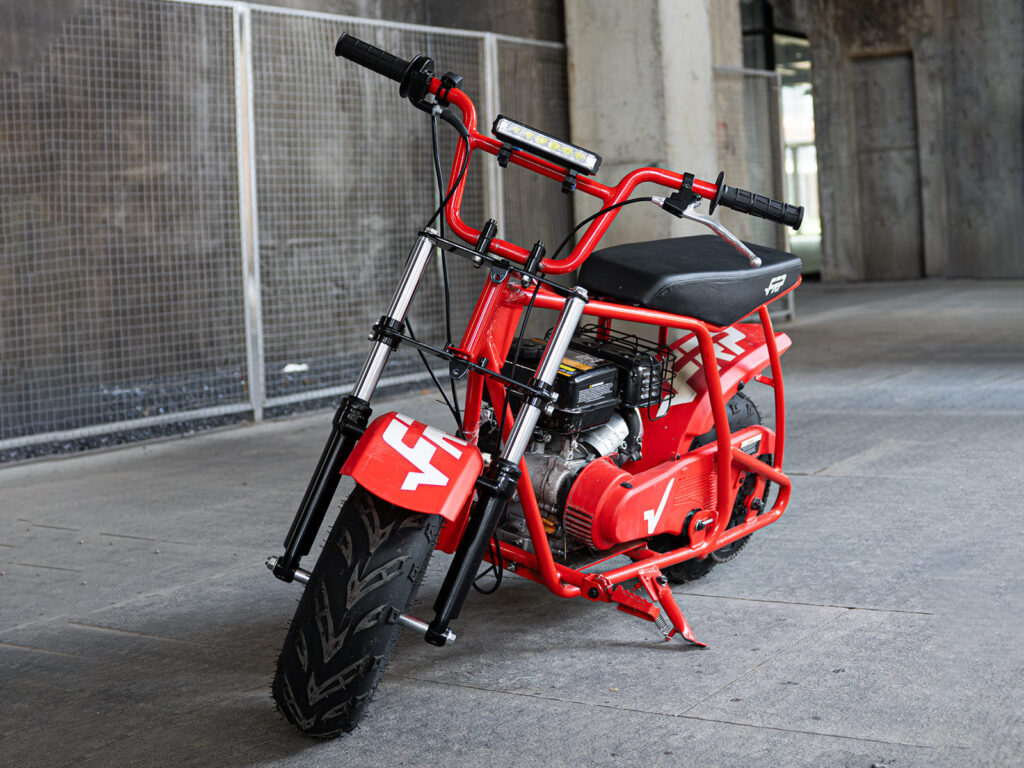
The FRP GMB100 99cc gas mini bike is one example of an entry-level bike built around that idea: a simple 99cc platform for teens and adults, with SunF tires, a rear disc brake and a frame that leaves an upgrade path open.
But is it worth paying more than the cheapest 99cc mini bike you can find?
Here is what actually matters.
Quick Answer
A basic 99cc mini bike can be a good purchase when you:
- Ride occasionally
- Stay mostly on flat, firm ground
- Care more about the lowest initial price than future upgrades
- Are comfortable sourcing replacement parts yourself
A better-supported 99cc mini bike may be worth paying more for when you:
- Want tires selected for a defined riding surface
- Need a bike sized for teens or adults
- Want model-specific replacement parts
- Plan to maintain or modify the bike over time
- Want a clear step-up option for rougher terrain
The mistake is comparing two bikes only by their engine labels.
“99cc” does not tell you how the rest of the bike is built.
What Does 99cc Actually Tell You?
The 99cc specification describes the approximate displacement of the engine.
It can help buyers estimate the general category of the bike, but it does not define:
- Top speed
- Rider weight capacity
- Tire quality
- Wheel strength
- Brake type
- Frame dimensions
- Ride comfort
- Terrain capability
- Parts availability
- Upgrade compatibility
Even top speed cannot be predicted from displacement alone.
Two 99cc mini bikes may use different gearing, tire diameters, engine tuning and governor settings. Rider weight and terrain also affect real-world performance.
That means this comparison is incomplete:
Bike A has a 99cc engine. Bike B also has a 99cc engine. Therefore, they are essentially the same.
They may belong to the same engine class, but the complete machines can still be designed for different users.
Cheap 99cc Mini Bike vs. Better-Supported Platform
| Buying factor | Lowest-cost 99cc mini bike | Better-supported 99cc platform |
|---|---|---|
| Initial price | Usually lower | Usually higher |
| Engine size | Often similar | Often similar |
| Tire supplier | May be unspecified | Identified tire options |
| Terrain guidance | Often unclear | Defined by tire and chassis setup |
| Replacement parts | May require generic matching | Model-specific parts available |
| Upgrade path | Depends on frame | Planned compatibility may be available |
| Product information | Basic specifications | More detailed fit and use guidance |
| After-sale support | Varies by seller | Brand-level support structure |
| Best for | Lowest-cost occasional use | Longer-term ownership |
The cheaper bike can still be the correct choice.
But the buyer should understand what has been removed from the price—not assume that all 99cc mini bikes provide the same package.
1. Start With Terrain, Not Price
Before comparing features, decide where the bike will actually be ridden.
Common surfaces include:
- Pavement
- Driveways
- Farm lanes
- Packed dirt
- Short grass
- Gravel
- Mud
- Rutted trails
- Ground with roots and repeated bumps
A rigid-frame mini bike can work well on flat or moderately uneven ground. It remains mechanically simple and generally costs less than a suspended model.
However, a rigid bike does not become a trail bike simply because it has aggressive-looking tires.
For flatter yards, hard-packed areas and casual property riding, the standard GMB100 is the simpler option. It uses a rigid chassis, a 99cc four-stroke engine and a rear disc brake.
For riders regularly crossing gravel, roots, bumps or descending uneven ground, the GMB100P is the more relevant comparison. It adds front suspension, a hydraulic rear brake and heavier-duty wheel equipment.
The decision is therefore not:
Which version is more expensive?
It is:
Which chassis matches the surface I will ride most often?
Paying for suspension when you ride only on smooth ground may be unnecessary. Saving money on a rigid bike when you regularly ride rough trails can create the opposite problem.
2. Tires Change How a Mini Bike Is Used
Tires are one of the most overlooked parts of a mini bike comparison.
Buyers often focus on engine displacement and top speed because those numbers are easy to compare. But the tires are the parts that actually connect the bike to the ground.
They affect:
- Traction
- Steering feel
- Braking grip
- Vibration
- Rolling resistance
- Stability on loose surfaces
- Wear on pavement
The standard GMB100 is currently offered with SunF 145/70-6 knobby tires. That tread pattern is intended to provide usable traction across dirt, grass and other mixed surfaces.
FRP also offers a SunF street-tire version for riders who spend more time on pavement and hard-packed ground.
A street-oriented tire generally provides a smoother contact pattern on hard surfaces. A more aggressive tread is better suited to loose dirt, gravel and mixed property use.
Neither tire is universally better.
The relevant question is whether the seller clearly defines the tire and its intended surface—or simply installs the lowest-cost tire available.
3. Adult Fit Matters More Than the Engine Badge
A mini bike can have enough engine power to move an adult while still being physically uncomfortable to ride.
Adult fit depends on several dimensions:
- Seat height
- Handlebar position
- Foot-peg position
- Wheelbase
- Distance between the seat and handlebars
- Rider weight rating
- Overall frame size
A small frame may feel acceptable during a short test ride but become cramped during longer use.
The GMB100 is positioned for teens and adults, with a listed maximum load of 220 lb. Its current standard configuration is rated at approximately 24 mph.
That does not mean every adult will find it equally comfortable. Taller riders may still prefer handlebar risers, adjusted controls or another frame size.
The correct buying question is not simply:
Can the engine move an adult?
It is:
Does the complete bike provide enough room and rated capacity for the intended rider?
4. Brakes Should Match the Terrain and Speed
A brake specification can look simple on a product page, but braking performance depends on the complete setup.
Factors include:
- Mechanical or hydraulic actuation
- Rotor size
- Caliper design
- Tire grip
- Rider weight
- Surface conditions
- Cable adjustment
- Pad condition
The standard GMB100 uses a rear disc brake. This is suitable for its role as a basic rigid-frame mini bike when properly adjusted and maintained.
The GMB100P adds a hydraulic rear brake. Hydraulic actuation can provide a different lever feel and stronger, more consistent braking input, particularly when the bike is used on rougher ground or at higher speeds.
That does not mean every beginner automatically needs the more expensive brake system.
A buyer using the bike casually on level property may be adequately served by the standard rear disc setup. A rider dealing with repeated downhill braking, loose gravel or more aggressive riding has a stronger reason to move to the hydraulic system.
Once again, terrain should determine the purchase—not the desire to select every available upgrade.
5. Parts Availability Affects the Real Cost
The purchase price is only the first cost of owning a gas mini bike.
Wear and maintenance items can include:
- Brake pads
- Chains
- Clutches
- Throttle cables
- Tires
- Tubes
- Air filters
- Pull-start assemblies
- Carburetors
- Bearings
- Sprockets
Generic parts may work, but the buyer has to identify the correct dimensions and compatibility.
That can be easy for an experienced builder. It can be frustrating for a first-time owner who does not know the required chain pitch, cable length or brake-pad shape.
A model-specific parts catalog reduces that uncertainty.
FRP maintains replacement and upgrade parts for the GMB100 platform, including chains, brake parts, throttle components, tires and engine-related components.
This does not make normal maintenance free. It makes it easier to identify the intended replacement rather than measuring and adapting unrelated parts each time something wears out.
A low initial purchase price becomes less attractive when a basic replacement part is difficult to identify six months later.
6. Consider Whether You Will Modify the Bike
Many buyers say they want a stock mini bike and begin looking at upgrades shortly afterward.
Common modifications include:
- Predator 212 engine swaps
- Hydraulic brake conversions
- Front suspension kits
- Different tires
- New handlebars
- Seat upgrades
- Exhaust systems
- Clutch changes
- Torque converters
- Cargo racks
Not every owner needs these modifications, and engine changes can affect safety and warranty coverage.
However, a platform with documented parts and upgrade compatibility gives the owner more options.
The GMB100 frame is promoted as having a path toward common horizontal-shaft engine builds, including Predator 212-style projects. That makes the standard bike relevant to buyers who want an affordable running mini bike now but may build something more customized later.
A bargain bike with an unusual frame, axle or engine-mount layout may be harder to modify—even when it was cheaper to purchase.
The important distinction is between:
- A bike that is inexpensive because it is simple
- A bike that is inexpensive because support and compatibility were left to the buyer
Those are not the same value proposition.
7. Do You Need the GMB100 or GMB100P?
The two models should not be treated simply as a cheap version and an expensive version.
They serve different terrain requirements.
Choose the GMB100 when:
- You primarily ride on flat ground
- Your routes include yards, driveways, farm lanes or packed dirt
- You want the simpler and lower-cost platform
- You are comfortable with a rigid frame
- You want a bike that can serve as a future modification base
Choose the GMB100P when:
- You regularly ride over gravel, roots or repeated bumps
- Front suspension will materially improve control and comfort
- You want a hydraulic rear brake
- You want the upgraded wheel package
- You expect more demanding off-road use


TheGMB100Pcurrently combines a 99cc four-stroke engine with front suspension, hydraulic rear braking and 2.0 heavy-duty rims.
Those upgrades matter most when the terrain gives them something to do.
Someone riding only on level pavement should not buy the GMB100P merely because the specification list is longer. Someone riding repeatedly on rough ground should not choose the standard bike merely because the initial price is lower.
8. When the Cheapest 99cc Mini Bike Is Enough
There are cases where buying the least expensive acceptable mini bike is rational.
A basic model may be enough when:
- It will be ridden only a few times per year
- The surface is flat and predictable
- The rider is comfortably within its size and weight limits
- The owner already knows how to source generic parts
- There are no plans for major modifications
- Local service or retailer support is available
Not every buyer needs premium tires, hydraulic brakes, suspension or an extensive upgrade catalog.
Paying for features that will never be used is not better value.
However, the buyer should verify the basics before purchasing:
- Who makes or sells replacement parts?
- What is the stated rider weight limit?
- What brake system is fitted?
- What terrain is the tire designed for?
- Is the bike intended for adults?
- Can the seller provide manuals or parts diagrams?
- What happens when a cable, chain or brake pad wears out?
When those questions cannot be answered, the cheaper price may come with more ownership uncertainty.
9. What Should You Compare Before Buying?
Use this checklist instead of comparing engine displacement alone.
Rider fit
Confirm the weight rating, seat height and general frame dimensions.
Terrain
Decide whether the bike will be used on pavement, packed ground or rough trails.
Tire type
Look at the actual tread and intended surface, not only the tire size.
Brake system
Check whether it uses a mechanical disc, hydraulic disc or another configuration.
Suspension
Determine whether the riding surface justifies the added cost.
Replacement parts
Look for brake pads, chains, cables, tires and engine service parts before buying the bike.
Upgrade compatibility
Consider whether you may later change the engine, brake, fork or drivetrain.
Assembly requirements
A lower price may come with more assembly, adjustment or troubleshooting.
Seller support
Check whether the seller supports the model after the initial transaction.
These factors usually reveal more about long-term value than the “99cc” label.
Final Verdict
The best 99cc mini bike for an adult is not automatically the fastest, the most heavily equipped or the least expensive.
It is the one that matches the rider, terrain and intended ownership path.
A low-cost 99cc mini bike can make sense for occasional riding on flat ground, especially for an owner who is comfortable sourcing generic replacement parts.
A supported platform becomes more valuable when the buyer expects to maintain the bike, change tires, replace wear items or modify the machine later.
The FRP GMB100 99cc mini bike is best understood as the accessible entry point: a rigid-frame bike for flatter terrain, fitted with SunF tires, a rear disc brake and a platform that can grow with the owner.
The GMB100P is the terrain-driven upgrade. Its front suspension, hydraulic rear brake and heavy-duty wheel package are relevant when the route becomes rougher—not merely when the buyer has a larger budget.
Do not choose a mini bike by engine displacement alone.
Choose it according to where you ride, what the complete chassis includes and whether the bike will still be supportable after the first season.
Safety notice: Gas mini bikes are intended for suitable off-road or private-property use where legally permitted. Riders should wear appropriate protective equipment, follow the manufacturer’s age and load guidance, inspect the brakes and controls before each ride and begin at low speed on a clear surface.

Ehatasamul Alom is a dedicated road hybrid bikes expert. With over 15 years of experience, he helps people find the perfect ride. He began his journey as a bike mechanic. He learned the ins and outs of every bike.
Ehatasamul Alom holds a Master's degree in Mechanical Engineering from a Brown University (Providence US 02912), where he specialized in material science and bicycle kinematics. His master's thesis focused on optimizing frame geometry for road hybrid bikes to improve rider comfort and efficiency.
Ehatasamul has an extensive professional background. He spent 10 years (2010-2020) as a Senior Bike Designer at "Urban Cycles," a leading bicycle manufacturer. In this role, he led the development of several award-winning road hybrid bikes, which are known for their durability and performance. He later served (2020-2024) as the Head of Product Development at "Gear Up," a company specializing in high-end cycling components. There, he developed innovative parts and accessories specifically for road hybrid bikes.
Over the years, Ehatasamul has become an authority on Roadhybridbikes. He understands their design and function. His work focuses on making bikes easy to use. Ehatasamul believes everyone should enjoy cycling. He writes guides that are simple to read. His passion for road hybrid bikes is clear. His goal is to share his knowledge with everyone. He wants to see more people on two wheels. His advice is always practical and easy to follow.
- Ehatasamul Alom

- Ehatasamul Alom
- Ehatasamul Alom
- Ehatasamul Alom