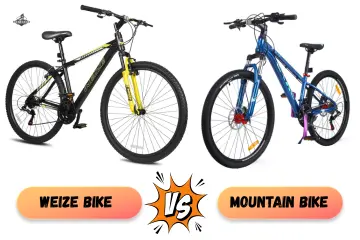
You see Weize listed as number one best seller on Amazon. It costs just one hundred ninety dollars. The listing says mountain bike. Weize vs mountain bike, But is it really?
I bought one to find out and I rode it on trails. I tested it against real mountain bikes. Now I can tell you the truth.
A WEIZE is a brand of affordable mountain bikes that usually come with dual suspension (shocks at both the front and back), have multiple gears (like 18 or 21), and are made from high-carbon steel or aluminum. These bikes are made for easy trail riding, getting to work, and staying fit.
They offer good value but are not as good for complex mountain biking as more expensive models. In this way, you can think of it as a comparison between WEIZE (a specific brand) and other mountain bikes (a general category), with WEIZE providing nice basic features but not the same level of performance as higher-end bikes.
The Key Difference: Cost vs. Quality
WEIZE stands out by offering a well-equipped and budget-friendly option that feels like an actual mountain bike for regular outings, managing rough terrain and inclines effectively without a high cost. Although a top-tier mountain bike provides better maneuverability, less weight, and more durability for advanced technical riding, the WEIZE is a great pick for beginners or anyone looking for a reliable bike for fitness and enjoyment on milder trails.
WEIZE Mountain Bikes (Details)
Suspension: Usually has a front fork and a rear coil shock (dual suspension) to help with bumps on the trail.
Frame: Often made from high-carbon steel (which is strong but heavier) or aluminum (which is lighter).
Gearing: Comes with 18 to 21 speeds, using Shimano or similar shifting systems to handle different types of terrain.
Brakes: Uses linear pull brakes (V-brakes) or sometimes disc brakes, which provide good stopping power.
Best For: Great for beginners, casual riders, light trail activities, commuting, and people who want to save money.
General Mountain Bikes (The Category)
Range: A wide selection is available, from basic hardtail models (which only have front suspension) to top-end full-suspension bikes made for serious trail and enduro riding.
Performance: Higher-quality bikes use advanced materials (like carbon fiber), have better suspension systems, lighter parts, and more accurate shapes for specific types of trails.
Cost: Prices vary greatly; entry-level bikes can be very affordable.
Weize vs. MTB: What Weize Actually Is?
Weize is a bike-shaped object marketed as a mountain bike. It rolls and has gears. But calling it a true mountain bike is misleading.
Real mountain bikes handle trails confidently. They have quality components. They last for years. Weize has none of these traits.
Weize works for paved paths only. Light casual use. Very flat terrain. Anything else breaks it fast.
The low price reflects actual quality. You get what you pay for here.
Understanding the Weize Brand
Weize makes budget bikes sold on Amazon. They focus on one thing. Low price.
The company sources bikes from Chinese factories. They apply their brand name. Then they sell through online marketplaces. No physical stores exist.
Marketing images look great. Specifications sound impressive. Dual suspension catches your eye. Eighteen speeds seem useful. Reality differs dramatically.
Customer reviews tell the real story. Many buyers report problems immediately. Others defend their purchase. Cognitive dissonance is powerful.
What Defines a Real Mountain Bike
Let me explain what makes a true mountain bike.
Real mountain bikes have strong frames. Steel or aluminum that can take hits. Welds are clean and tested. Geometry is designed for off-road use.
Suspension actually functions. Forks have damping and rebound control. Travel ranges match intended use. Rear suspension uses proper linkages.
Components come from known brands. Shimano, SRAM, or Microshift at minimum. Parts work together properly. Everything is tested extensively.
Wheels are built to last. Spokes are properly tensioned. Hubs use sealed bearings. Rims can handle impacts.
True mountain bikes cost more for good reasons. Engineering takes time. Quality materials cost money. Testing ensures safety.
Weize Specifications Breakdown
Let me walk through what Weize actually offers.
The frame is high-carbon steel. Sounds fancy but it is just heavy steel. Welds are rough with visible gaps. Paint hides poor metalwork. Weight reaches forty-eight pounds.
Dual suspension is listed. The front fork has coil springs only. No damping exists. The rear shock is decorative mostly. It compresses but does nothing useful.
Eighteen speeds sound good. But the drivetrain uses no-name components. Shifters are twist-grip style. They feel mushy and imprecise. Derailleurs are basic copies.
Brakes are linear pull style. This means cable-actuated rim brakes. Not the disc brakes shown in some photos. Stopping power is weak. They fade quickly on descents.
Wheels have alloy rims. But they are single-wall construction. Very weak. Hubs use loose ball bearings. These need constant adjustment.
Assembly Experience Reality
The listing says twenty-minute assembly. That is optimistic at best.
My Weize arrived in a box. The front wheel was separate. Handlebars needed attaching. Pedals needed installation. Seat required adjustment.
Instructions were poor quality. Grainy black and white images. Text had translation errors. Many steps were unclear.
I spent ninety minutes on assembly. Nothing lined up perfectly. The front wheel did not sit straight. Handlebars would not tighten properly. Brakes needed extensive adjustment.
Even after careful work, issues remained. The rear derailleur would not index correctly. Front brake rubbed constantly. Wheels had visible wobble.
A bike shop charges seventy-five to one hundred dollars for assembly. Many Weize buyers need this service. Add that to the actual cost.
First Ride Impressions
I took my assembled Weize for a test ride.
The bike feels heavy immediately. Pedaling requires serious effort. Even on flat pavement, it is sluggish. Weight is noticeable when starting.
Shifting gears is frustrating. The twist shifter turns but gears do not change. Sometimes it shifts two gears at once. Sometimes nothing happens. Chain noise is constant.
Brakes barely work. I squeeze hard for minimal stopping. On a slight downhill, I cannot stop quickly. This is dangerous in traffic.
The seat is uncomfortable after ten minutes. Padding is thin. Shape does not fit well. My sit bones hurt.
Riding position feels awkward. Handlebars are too high. Seat is too low even fully raised. Geometry does not fit human bodies well.
This was on smooth pavement. I had not hit trails yet.
Trail Performance Testing
I took the Weize to an easy local trail. Nothing technical. Just dirt path with some roots.
The bike felt unstable immediately. Loose steering made me nervous. Weight made maneuvering hard. I rode slowly from the start.
The first root hit hard. The fork did nothing. Impact jarred my hands badly. I nearly lost control. This happened at every obstacle.
Climbing a gentle hill was exhausting. The bike weighs so much. Gears slipped under power. I stood up to pedal. Chain fell off completely.
I stopped to put the chain back. It took five minutes. Grease got all over my hands. I continued carefully.
A small downhill section came next. I tried to brake. Nothing happened at first. Then brakes grabbed suddenly. Rear wheel skidded. I almost crashed.
Technical sections were impossible. Rocks bounced me around. The bike had no traction. No stability. No confidence.
I turned around after one mile. The return was equally miserable. I vowed never to take this bike on trails again.
Component Quality Analysis
Let me break down each part system.
The drivetrain uses no-brand parts. The front derailleur is stamped steel. It flexes under shifting. The rear derailleur has plastic pulleys. These wear out fast.
Shifters have no model numbers. Internal mechanisms feel cheap. Cables fray quickly. Housing compresses. Shifting gets worse over time.
The chain is basic. It stretches fast. Links bind easily. Cleaning helps but replacement comes soon. A decent chain costs fifteen dollars.
Crank arms are steel. Bottom bracket uses cup and cone bearings. These need frequent adjustment. They fail after months of use. Pedals are plastic with cheap bearings.
Brakes are the worst part. Brake arms are soft metal. Cable pulls are inefficient. Pads are hard compound. They do not grip well. Replacement pads cost ten dollars but barely improve things.
Weize vs Mountain Bike: Suspension System Reality
The dual suspension claim is misleading marketing.
The front fork has coil springs. These compress easily. But no damping exists. The fork bounces back instantly. You feel the bump twice. Once going down, once bouncing back.
Fork stanchions are steel. Not smooth. They bind and stick. Seals are basic. They leak after minimal use. The fork weighs about six pounds alone.
Rear suspension is fake essentially. The shock body is mostly decorative. It has a spring inside. But the pivot points are wrong. The geometry does not work. Maybe one inch of actual travel.
The rear triangle flexes instead of pivoting properly. This wastes your pedaling energy. Climbing efficiency is terrible. The suspension works against you.
True suspension costs hundreds of dollars. What Weize offers costs maybe twenty dollars. The difference shows immediately.
Weize vs Mountain Bike: Durability and Lifespan
How long does a Weize bike last? Not long at all.
Within the first week, problems emerged. Spokes started breaking. Three snapped on the rear wheel. The wheel went badly out of true. Riding became dangerous.
The bottom bracket developed play. Cranks wobbled side to side. This got worse daily. Soon it needed complete replacement.
Brake pads wore down in two weeks. Mind you, this was light use. Maybe thirty miles total. Replacement pads lasted just as long.
The chain stretched noticeably. Shifting became impossible. Even after adjustment, it skipped constantly. Chain replacement was needed at one month.
Bearings in the headset loosened. Handlebars developed play. Tightening helped temporarily. But proper adjustment required tools I did not have.
After three months of occasional use, major repairs were needed. The cost approached one hundred fifty dollars. This is seventy-five percent of the bike’s price.
Many online reviewers report similar experiences. Some had chains break while riding. Others had pedals fall off. Wheels collapsing is common.
The bike is essentially disposable. Plan on one season maximum. Maybe two if you barely ride it.
Comparison with Entry-Level Real Mountain Bikes
Let me compare Weize to actual budget mountain bikes.
A Trek Marlin Five costs around six hundred dollars. That is three times more than Weize. But you get exponentially more bike.
The Trek frame is proper aluminum. It weighs less despite being stronger. Geometry is designed correctly. Welds are clean and tested.
Trek uses name-brand components. Shimano Tourney drivetrain works reliably. Tektro brakes stop you properly. Wheels are built correctly.
Trek assembly is professional if bought at a shop. Everything works right from day one. No immediate repairs needed.
Trek lasts years with basic care. Weize lasts months. The Trek holds resale value. Weize has none.
Even a cheaper option like Schwinn Axum works better. It costs four hundred dollars. Components are better than Weize. Frame is stronger. Lifespan is longer.
The price difference makes sense. Real mountain bikes cost more to make. They use better materials. They have proper design. Also, They go through testing.
Key Features Comparison Table
Here is how Weize compares to real mountain bikes.
Weize has high-carbon steel frame. Real mountain bikes use aluminum or chromoly steel. Weize weighs forty-eight pounds. Real mountain bikes weigh thirty to thirty-five pounds.
Weize has fake dual suspension. Real mountain bikes have functional suspension or none at all. Weize uses no-name components. Real bikes use Shimano or SRAM.
Weize has linear pull brakes. Real mountain bikes have mechanical disc brakes minimum. Weize has single-wall rims. Real bikes have double-wall rims.
Weize costs one hundred ninety dollars. Real mountain bikes start at four hundred dollars. Weize lasts three to six months. Real bikes last three to five years minimum.
Weize suits paved paths only. Real mountain bikes handle actual trails. Weize needs constant repairs. Real bikes need normal maintenance.
Who Should Consider Weize
Very few people should buy this bike.
Weize might work for absolute beginners on flat pavement. People who ride once per month. Very short distances under two miles. Those who cannot afford anything better.
Even then, a used bike from a real brand is better. Check Craigslist or Facebook Marketplace. A five-year-old Trek beats a new Weize easily.
Kids might be an exception. They outgrow bikes fast anyway. But even for kids, this bike is heavy. It discourages riding. Better bikes help kids learn faster.
Apartment dwellers with storage issues might consider it. The bike is disposable essentially. Throw it away when it breaks. But this creates waste. Not environmentally friendly.
I cannot recommend Weize for anyone who actually wants to mountain bike. Not even on easy trails. The bike simply cannot handle it. Disappointment is guaranteed.
Who Should Avoid Weize
Most people should skip this bike entirely.
Anyone wanting to ride trails should avoid Weize. Even beginner-level trails exceed its capability. The bike will break. You might get hurt.
Regular riders need better bikes. If you ride weekly, Weize will not last. Constant repairs become expensive. Frustration kills your enjoyment.
Heavier adults should definitely avoid it. The weight limit is two hundred seventy-five pounds. But the bike feels flimsy well below that. Components are not built for larger riders.
Taller riders will not fit well. Even at the height range listed, proportions are off. Handlebars and seat positions do not adjust properly. Comfort is impossible.
Anyone who values their time should pass. Time spent repairing Weize exceeds time spent riding. This defeats the purpose of owning a bike.
Real Customer Experience Summary
Let me share what actual buyers report.
Positive reviews mention easy assembly. Low price. Decent for paved riding. Some say it works for their needs. Many are first-time bike buyers with no comparison point.
Negative reviews dominate though. Common complaints include chains breaking. Spokes snapping. Brakes failing. Gears not working. Parts arriving damaged.
Many reviewers needed immediate repairs. Some took bikes to shops. Mechanics often refuse to work on them. The bikes are too cheap to fix properly.
Several buyers reported injuries. Brake failures caused crashes. Chain breaks threw riders off balance. Wheel collapses led to falls. These are serious safety issues.
Customer service gets mixed reviews. Some report helpful responses. Others get ignored completely. Replacement parts are hard to source. Full bike replacements happen sometimes.
The four-point-one star rating is misleading. Many five-star reviews are from day one. Before problems emerge. Long-term reviews are much lower.
Reading between the lines reveals the truth. This is not a real mountain bike. It is a bike-shaped object for occasional pavement use only.
Maintenance Requirements and Costs
Weize demands constant attention. Let me detail what you face.
Daily checks are necessary. Tighten all bolts before each ride. Pedals, stem, cranks, seat. Everything loosens constantly. This takes ten minutes.
Weekly maintenance includes adjusting brakes. They go out of alignment constantly. Pads wear unevenly. Cable stretch is rapid. Budget thirty minutes weekly.
Monthly tasks include chain replacement potentially. Definitely lubrication. Spoke tensioning. Derailleur adjustment. This takes an hour minimum.
Tools needed include allen keys, screwdrivers, chain tool, spoke wrench, and cable cutters. Good tools cost seventy-five dollars minimum. Cheap tools make work harder.
Replacement parts add up fast. Chains cost fifteen dollars. Brake pads ten dollars. Cables and housing fifteen dollars. Spokes one dollar each but you need a dozen. Tubes eight dollars each.
Annual costs for parts approach one hundred fifty dollars. That is if nothing major breaks. If the bottom bracket fails, add fifty dollars. If wheels need complete rebuilding, add one hundred dollars.
Compare this to a real mountain bike. Annual maintenance runs fifty to one hundred dollars. Parts last longer. Fewer surprises occur.
True Cost of Ownership Analysis
Let me break down what Weize actually costs over time.
Initial purchase is one hundred ninety dollars. Assembly tools add twenty-five dollars if needed. Professional assembly adds seventy-five dollars if you cannot do it.
First month repairs average fifty dollars. Brake pads, chain adjustment, spoke replacement. These are common issues reported by buyers.
Second and third months add another fifty dollars. More spokes. Bottom bracket adjustment. Cable replacement. Problems accelerate.
By month six, major repairs are needed. Wheels rebuilt for seventy-five dollars. Bottom bracket replaced for fifty dollars. Total additional cost is one hundred twenty-five dollars.
Six-month total reaches four hundred forty dollars. This assumes you do some work yourself. Professional help raises costs significantly.
At this point, the bike barely functions. Many owners give up. They buy a better bike. The Weize gets thrown away or given away.
Compare to buying a four hundred dollar real mountain bike. Maintenance for six months costs maybe fifty dollars. Total is four hundred fifty dollars. Just ten dollars more than the Weize experience.
But the real bike still works great. It will last years longer. The value difference is enormous.
Why the Low Price Creates Problems
The one hundred ninety dollar price tag enables the issues.
Manufacturing costs must be incredibly low. Maybe fifty dollars per bike total. This includes materials, labor, and shipping from China.
Quality control is impossible at this price. No one inspects welds carefully. No one tests components thoroughly. Defects slip through constantly.
Materials must be the absolute cheapest. Steel instead of aluminum. Plastic instead of metal. Generic instead of name-brand. Every penny is shaved.
Engineering does not happen. The design is copied from others. No testing occurs. No refinement happens. Problems are never fixed.
Customer service is minimal. Support staff cannot help much. Replacement parts are not stocked. The company wants you to just buy another bike.
The business model depends on volume. Sell thousands of bikes. Accept high defect rates. Rely on permissive return policies from Amazon. Ignore long-term reputation.
This is not how real bike companies operate. They invest in design. They test extensively. Also, They stand behind products. This costs money but delivers quality.
Marketing versus Reality
The listing and photos promise more than delivered.
Marketing images show bikes on mountain trails. Riders look confident and happy. The bike appears capable. This is misleading advertising.
Specifications list impressive features. Dual suspension sounds advanced. Eighteen speeds seem versatile. High-carbon steel sounds premium. None of this reflects actual performance.
The number one best seller badge is deceiving. It reflects sales volume, not quality. Low price drives sales. Many buyers do not research carefully.
Customer photos tell a different story. Bikes on flat pavement. Close-ups of broken parts. Complaints in review text. Reality sets in after purchase.
Video reviews from actual users are revealing. Watch them ride. Listen to the noise. See the wobbles. Compare to their real mountain bikes.
The Weize store page has demonstration videos. These show ideal conditions. Perfect pavement. Gentle slopes. Light riders. Not representative of normal use.
Marketing exploits buyers who do not know better. First-time bike buyers are the target. People who cannot tell the difference yet. Those focused only on price.
Weize vs Mountain Bike: Safety Concerns You Should Know
Weize bikes present real safety risks. This is serious.
Brake failure is the biggest concern. Multiple reviewers report brakes not working. On hills or in traffic, this causes crashes. Injuries result.
Chain breaks happen regularly. When a chain snaps under pedaling force, you lurch forward. Balance is lost. Falls occur. Some riders report road rash and bruises.
Wheel collapses are dangerous. Spokes break causing wheels to fold. If the front wheel collapses, you go over the handlebars. Broken bones can result.
Loose parts create hazards. Pedals falling off mid-ride. Handlebars coming loose. Seat posts slipping. Any of these causes loss of control.
The bike is unstable at speed. Poor geometry and flexy frame create wobbles. Going fast feels scary. Panic braking makes things worse.
On actual trails, risks multiply. The bike cannot handle terrain. You go slower to compensate. But even slow speeds feel unsafe. You question every obstacle.
Real mountain bikes have safety margins. Components exceed minimum requirements. Testing reveals problems before sale. Recalls happen if issues emerge.
Weize has no such safety culture. The bike meets no recognized standards. No testing occurs. You are the crash test dummy.
Environmental and Ethical Considerations
The disposable nature creates waste. Think about this.
Each Weize bike lasts months before breaking. Then it goes to a landfill. Steel frame, rubber tires, plastic parts. None of it gets recycled usually.
Thousands of these bikes get thrown away yearly. This is unnecessary waste. A better bike lasting five years replaces five Weize bikes.
Manufacturing cheap bikes has environmental costs. Low-quality factories pollute more. Rush production uses more energy. Shipping from China creates emissions.
Labor conditions in factories are questionable. The extremely low price suggests workers are not paid fairly. No transparency exists.
The disposable culture is unsustainable. Encouraging people to buy and discard bikes within months is wrong. This is not how cycling should work.
Real bike companies focus on durability. They want bikes to last decades. Replacement parts are available long-term. Repairs are encouraged.
Some companies offer trade-in programs. Or donate old bikes. Or recycle materials properly. Weize offers none of this.
Buying quality means buying less often. This is better for the planet. Better for your wallet long-term. Better for your sanity.
Alternatives at Similar Budgets
Let me suggest real options in this price range.
Used bikes from real brands are best. A five-year-old Trek or Specialized. These sell for two hundred to three hundred dollars. They ride infinitely better than new Weize.
Look on Craigslist, Facebook Marketplace, or local bike swaps. Test ride before buying. Check for frame damage. Bring a knowledgeable friend if possible.
Walmart sells better budget bikes than Weize. Schwinn and Mongoose models run two hundred fifty to three hundred fifty dollars. These are not great but they function better.
Police auctions often have bikes. These were stolen and never claimed. You get decent bikes cheap. Support your local police department.
Bike co-ops exist in many cities. They refurbish donated bikes. Sell them cheap to promote cycling. Volunteers help you find the right bike. Prices range from fifty to two hundred dollars.
Wait and save for a better bike. Add two hundred dollars to your budget. Suddenly real options appear. Trek Marlin. Giant ATX. Specialized Rockhopper. These are legitimate mountain bikes.
Consider hardtail mountain bikes only. Full suspension in this price range is always fake. A good hardtail beats bad full suspension every time.
Buy from local bike shops. They offer expertise. Test rides. Proper fitting. Assembly. Ongoing support. This value exceeds the small price difference.
My Final Verdict on Weize vs Mountain Bike
After extensive experience, my conclusion is clear.
Weize is not a true mountain bike. It is a bicycle-shaped object marketed deceptively. The low price reflects actual quality accurately.
For occasional paved riding, Weize barely functions. For actual mountain biking, it fails completely. The bike cannot handle trails safely.
The true cost including repairs exceeds better options. The frustration cost is immeasurable. Constant problems ruin riding enjoyment.
Safety concerns alone should disqualify Weize. Brake failures, chain breaks, and wheel collapses risk injury. No bike is worth getting hurt over.
Better alternatives exist at every price point. Used real bikes. Budget models from legitimate brands. Saving slightly longer for quality.
The best seller status misleads buyers. Sales volume reflects aggressive pricing, not quality. Thousands of disappointed customers prove this.
I recommend avoiding Weize entirely. Your money is better spent elsewhere. Your safety deserves better. Also, Your riding experience should be enjoyable, not frustrating.
If someone gave me a Weize for free, I would sell it immediately. Use the money toward a real bike. That is how little confidence I have in this product.
The cycling community deserves honesty. Weize represents everything wrong with race-to-bottom pricing. Quality matters. Safety matters. Durability matters.
Choose a real bike. Even a used one. Your future self will thank you. Your rides will be enjoyable. Also, Your bike will actually last.
The trail awaits. But not on a Weize. Get a real mountain bike instead.
FAQs
Weize bikes are decent for casual riding. They offer low-cost and simple designs.
Neither is better for everyone. Road bikes are fast on pavement, while mountain bikes handle rough trails.
Hybrid bikes are slower than road bikes. They are also weaker on rough trails than mountain bikes.
The best type depends on where you ride. Hybrid bikes suit mixed roads and light paths.
You can use a hybrid on light trails. It is not made for rough or steep terrain.
Yes, hybrid bikes are good for long rides. They offer comfort and an upright position.
Hybrid bikes handle hills well. They have wide gears and steady balance.
Hybrid bikes are not great in snow. Their tires lack grip on soft surfaces.
Fat bikes are better on snow and sand. Mountain bikes are better on normal trails.
A hybrid is better for roads and paths. A mountain bike is better for rough trails.

Co-Founder, Owner, and CEO of RoadHybridBike.
Ehatasamul Alom is a dedicated road hybrid bikes expert. With over 15 years of experience, he helps people find the perfect ride. He began his journey as a bike mechanic. He learned the ins and outs of every bike.
Ehatasamul Alom holds a Master’s degree in Mechanical Engineering from a top university, where he specialized in material science and bicycle kinematics. His master’s thesis focused on optimizing frame geometry for road hybrid bikes to improve rider comfort and efficiency.
Ehatasamul has an extensive professional background. He spent 10 years as a Senior Bike Designer at “Urban Cycles,” a leading bicycle manufacturer. In this role, he led the development of several award-winning road hybrid bikes, which are known for their durability and performance. He later served as the Head of Product Development at “Gear Up,” a company specializing in high-end cycling components. There, he developed innovative parts and accessories specifically for road hybrid bikes.
Over the years, Ehatasamul has become an authority on road hybrid bikes. He understands their design and function. His work focuses on making bikes easy to use. Ehatasamul believes everyone should enjoy cycling. He writes guides that are simple to read. His passion for road hybrid bikes is clear. His goal is to share his knowledge with everyone. He wants to see more people on two wheels. His advice is always practical and easy to follow.
Leave a Reply
You must be logged in to post a comment.