Getting tire pressure right is one of the fastest, cheapest upgrades any cyclist can make. A good tire pressure guide tells you this is not just about a number on a gauge. It is about how your bike responds to the road, how your hands feel after an hour of riding, and how much effort it takes to hold your pace. Riding the streets of Nashville, Tennessee, where smooth city blocks mix with cracked side roads and occasional packed gravel, I learned that the right PSI for one stretch of road is not always right for the next. This guide breaks down everything you need to know, from the basics to the fine-tuning, so your hybrid bike feels exactly the way it should on any surface.
What Is Tire Pressure and Why It Matters for Hybrid Bikes
Tire pressure is not just a maintenance checkbox. It is one of the most direct ways your bike communicates with the road beneath you.
Simple Definition (No Technical Overload)
Tire pressure is the amount of air inside your tire, measured in PSI, which stands for pounds per square inch. That number controls three things that matter to every rider: grip, rolling resistance, and comfort. Too much air and the tire gets rigid, bouncing over every crack and bump. Too little air and the tire squishes down, creates more drag, and puts you at risk of a pinch flat on sharp edges.
PSI is the standard unit used in the United States. Some tires and pumps also show bar, which is the European measurement. They refer to the same thing. A conversion worth knowing: 1 bar equals roughly 14.5 PSI. Most hybrid bike riders in the US work in PSI, and that is how this guide presents every number.
Why Hybrid Bikes Need Balanced Pressure
Hybrid bikes are built to handle two different worlds: smooth pavement and light unpaved surfaces. That dual purpose creates a unique pressure challenge. A road bike can run at 90 to 100 PSI because it rides smooth asphalt at high speed. A mountain bike drops to 25 to 35 PSI because it needs grip and cushion on loose, rough terrain.
A hybrid sits between both. Its tires are wider than a road bike but narrower than a mountain bike. Its geometry balances speed with upright comfort. That design means the optimal PSI range for a hybrid, generally 40 to 70 PSI, is intentionally in the middle. Not road-bike firm. Not mountain-bike soft. A balanced setup that handles whatever your typical route throws at you.
Real Ride Context
A few months into riding my hybrid regularly, I noticed something frustrating. My commute felt sluggish some mornings and jumpy on others. I was not changing my route or my effort. The problem was my tires. I had never paid attention to how much air was in them from ride to ride.
One morning I checked and found the tires at about 45 PSI, when my tire sidewall showed a range up to 70 PSI. That explained the sluggish feeling. Another time, someone at my local shop filled them to the maximum marked on the sidewall as a favor before a weekend ride. Every seam, pothole, and raised crack sent a harsh jolt through my hands and arms. That was too firm for the roads I ride.
Finding the middle ground fixed both problems. That simple adjustment changed how the bike felt more than anything else I had done.
Recommended Tire Pressure for Hybrid Bikes (PSI Range)
There is no single correct number for every rider on every tire on every road. But there is a smart, data-supported range you can start from.
General PSI Range for Hybrid Bikes
Most hybrid bike tires perform well between 40 and 70 PSI. That range reflects the dual-purpose nature of the bike. Some narrower hybrid tires designed for faster city riding can go up to 75 or 80 PSI without issue. Wider comfort-oriented tires often work best in the 40 to 55 PSI zone.
Your starting point within that range depends on two things above all else: your tire width and your body weight. Get both of those factors right and your initial setup will be close to ideal. Then you fine-tune from there based on feel and terrain.
One important rule applies regardless of everything else: never exceed the maximum PSI printed on the tire sidewall. That number is a structural limit, not a target. Exceeding it risks a blowout and can damage your rim. Many riders mistakenly treat the maximum as the recommended number. It is not. The recommended pressure is almost always several PSI below the maximum.
How Tire Width Changes PSI Needs
Wider tires hold more air volume. That extra volume means the tire can support your weight at lower pressure without collapsing or bottoming out on bumps. Narrower tires have less air volume, so they need more pressure to do the same job.
This is the fundamental physics Lennard Zinn, long-time technical writer for VeloNews and author of the widely read Zinn and the Art of Road Bike Maintenance, has explained in his research and writing for decades. In his words from Zinn Cycles, wider tires roll faster, grip better, and ride more comfortably when run at lower pressure than many riders expect. The relationship is proportional: as tire width increases, optimal pressure decreases.
For hybrid bikes specifically, a 32mm tire typically performs well at 55 to 70 PSI. A 45mm tire on the same bike, carrying the same rider, works better at 40 to 55 PSI. The tire got wider. The pressure went down. Both setups can feel equally firm and supportive because the larger air volume compensates for the lower pressure.
Rider Weight Impact on Pressure
Your weight is the other major pressure variable. Heavier riders compress the tire more under load. That compression requires higher pressure to maintain the tire’s shape, prevent rim contact on hard bumps, and keep rolling resistance at a reasonable level.
A practical guideline that appears consistently across cycling research and mechanic experience: for every 20 pounds of body weight above 160 pounds, add roughly 2 to 3 PSI within your tire’s recommended range. Lighter riders, conversely, can run toward the lower end of the range and gain comfort and grip without risk.
The rear tire always carries more of your body weight than the front. A good starting practice is to run the rear tire 3 to 5 PSI higher than the front. This small asymmetry improves balance, reduces rolling resistance on the rear, and gives the front tire a slightly softer contact patch for better steering response.
Hybrid Bike Tire Pressure by Tire Width
After years of testing different pressures on different hybrid setups, I put together the table below as a real-world starting framework. These numbers align with manufacturer guidance and the weight-based adjustments confirmed across multiple cycling research sources. Use them as your starting point, then adjust up or down by 3 to 5 PSI based on how your ride feels on your specific roads.
| Tire Width | Light Rider (under 150 lbs) | Medium Rider (150 to 190 lbs) | Heavy Rider (over 190 lbs) |
|---|---|---|---|
| 32mm | 55 to 60 PSI | 60 to 65 PSI | 65 to 70 PSI |
| 35mm | 50 to 55 PSI | 55 to 60 PSI | 60 to 65 PSI |
| 40mm | 45 to 50 PSI | 50 to 55 PSI | 55 to 60 PSI |
| 45mm | 40 to 45 PSI | 45 to 50 PSI | 50 to 55 PSI |
How to Find the Perfect Tire Pressure (Step-by-Step)
No single ride tells you everything. But a simple four-step process gets you close on day one and better with each adjustment.
Step 1: Check the Tire Sidewall
Every bicycle tire has its pressure range printed on the sidewall. Look for a line that says something like “Min: 40 PSI / Max: 70 PSI” or similar wording. That range is the only pressure window your tire is designed to operate safely within.
Stay inside that range at all times. Riding below the minimum increases your risk of pinch flats, rim damage, and poor handling. Going above the maximum risks a dangerous blowout. The sidewall information is your non-negotiable boundary before any other factor comes into the picture.
Also note the valve type your tire uses. Schrader valves look like car tire valves: wide and with a small pin in the center. Presta valves are narrower and have a locking nut at the top. Make sure your pump head matches your valve type before you try to inflate.
Step 2: Start in the Middle Range
Once you know your tire’s pressure range, find the midpoint and start there. If your tire allows 40 to 70 PSI, start at around 55 PSI. If it allows 50 to 80 PSI, start at around 65 PSI.
Starting in the middle gives you equal room to go up or down based on feel. It also keeps you away from both extremes while you learn how your specific tires, your weight, and your usual roads interact with different pressures.
Pump your tires before every ride. Tires lose air naturally over time, even without a puncture. Leaving them unchecked for a week can mean riding on significantly less pressure than you set, which changes how the bike handles without any warning.
Step 3: Adjust Based on Feel
After your first ride at the starting pressure, pay attention to two things: comfort and resistance.
If the ride felt harsh on normal roads, harsh meaning every small crack or road seam sent a noticeable shock through your hands, the pressure is likely too high. Reduce by 3 to 5 PSI.
If the ride felt slow and sluggish, or if the bike felt like it was rolling through thick resistance, the pressure may be too low. Add 3 to 5 PSI and try again.
Make one adjustment at a time. Changing by 5 PSI per test session lets you feel the difference clearly without overshooting your target in either direction.
Step 4: Test on Your Usual Route
Test your adjusted pressure on the same road you ride most often. Familiar terrain lets you compare how the bike felt at different pressures without road surface changes clouding your judgment.
After two or three sessions of small adjustments, most riders find their preferred pressure within a 5 PSI range and stay there. That personal sweet spot balances your weight, your tire width, and the roads you ride. Write it down. That number is your baseline from now on.
Road vs Trail Riding: Pressure Differences
Where you ride changes what pressure you need. This is one of the most practical parts of a tire pressure guide for hybrid riders because most of us ride more than one type of surface.
Smooth Roads (City Riding)
City roads, bike paths, and smooth asphalt favor higher pressure within your tire’s range. Higher PSI reduces the tire’s contact patch, which lowers rolling resistance. The bike moves more efficiently. You go faster at the same effort.
On smooth surfaces, there are fewer bumps to absorb, so the harsher ride quality at higher pressure is less of a problem. The ground is consistent and predictable, and your tires do not need to flex and conform around obstacles. A firmer setup works better here.
For most hybrid riders on smooth city roads, sitting in the upper third of your tire’s recommended range delivers the best combination of speed and comfort.
Rough Roads and Broken Pavement
Cracked pavement, chip-seal roads, and broken sidewalk sections change the equation entirely. Hard tires on rough roads bounce. Every bounce is a small energy loss that slows you down and tires your hands and arms.
Dropping pressure by 5 to 10 PSI from your smooth-road setting lets the tire deform slightly around road irregularities. That flex absorbs energy that would otherwise reach your hands and body. The ride becomes noticeably smoother. You also get better traction as the tire maintains a more consistent contact patch on uneven surfaces.
This is not just about comfort. Rolling resistance research by Lennard Zinn and colleagues at Wheel Energy in Finland consistently showed a U-shaped curve: rolling resistance peaks at very low pressure, decreases to a minimum at an optimal midpoint, then increases again at very high pressure. On rough roads, that optimal minimum pressure is lower than most riders expect.
Light Trails and Gravel
Light gravel paths, packed dirt, and smooth trails benefit from the lowest pressure in your hybrid’s range. Lower pressure increases the tire’s contact patch with the ground, which improves grip on loose, variable surfaces.
More grip means more confidence in corners and on slight descents. It also reduces the jarring feel that makes gravel uncomfortable at high pressure. The tire rolls over small rocks and roots rather than bouncing off them.
One caution: do not go below the minimum pressure on your tire sidewall, even on soft surfaces. Excessively low pressure on a hybrid tire increases pinch flat risk, where the inner tube gets pinched between the tire and rim on a sharp impact. Stay within the recommended range even at the lower end.
Terrain-Based Tire Pressure Guide
This table comes from real riding experience across different surface types, matched against the physics of tire deformation and rolling resistance. Use it alongside your tire width and weight table to dial in the right starting PSI for any ride.
| Terrain Type | Recommended PSI | Riding Feel | Key Benefit |
|---|---|---|---|
| Smooth City Road | 60 to 70 PSI | Fast and firm, efficient pedaling | Lower rolling resistance, more speed |
| Rough or Broken Road | 50 to 60 PSI | Balanced, absorbs road shock | Comfort plus traction |
| Gravel or Light Trail | 40 to 50 PSI | Softer, more stable on loose ground | Grip and vibration absorption |
| Mixed Route | 55 to 60 PSI | Versatile, handles transitions well | Good all-around compromise |
Common Tire Pressure Mistakes (And Fixes)
Most tire pressure problems fall into a short list of repeating patterns. Recognizing them early saves you from rides that are harder than they need to be.
Overinflating Tires
Pumping tires to the maximum PSI printed on the sidewall is the most common mistake new riders make. The maximum is a structural safety limit, not a recommendation. Riding at maximum pressure makes the tire rigid, which causes it to skip over small bumps rather than roll through them.
The practical effects of overinflation are real and measurable. Your hands feel every road seam. Your contact patch shrinks, reducing grip during cornering and braking. On wet roads, an overinflated tire loses traction faster than one at proper pressure. On cracked pavement, it bounces instead of rolling smoothly.
The fix is simple. Drop your pressure 5 to 8 PSI below the maximum and ride the same road. You will likely feel an immediate improvement in comfort without any noticeable loss of efficiency.
Underinflating Tires
Underinflated tires are the second most common issue, especially among riders who never check pressure between rides. Tires lose air gradually over days and weeks even without a puncture. A tire inflated correctly on Monday may be 10 PSI low by the following weekend.
Riding on underinflated tires feels slow and heavy. The tire deforms too much under load, increasing rolling resistance noticeably. Worse, a soft tire on a sharp edge like a pothole rim, a curb drop, or a raised crack can compress completely and cause the tube to pinch against the metal rim. That pinch punctures the tube in a distinctive way, often creating two small holes side by side, which mechanics call a snake bite flat.
Check your pressure before every ride. It takes 60 seconds. It prevents slow rides, tired legs, and unexpected flats.
Ignoring Regular Checks
Tires lose air naturally through diffusion, the slow process by which air molecules pass through the rubber over time. Even a perfectly sealed tire with no punctures will lose 5 to 15 PSI per week depending on tire construction and temperature.
Weekly pressure checks are the minimum habit for any regular rider. Before a long ride or after a gap of several days without riding, always check before clipping in. A floor pump with a built-in gauge makes this quick and accurate. Keep the pump near your bike so the habit stays easy to maintain.
Tools to Measure and Maintain Tire Pressure
You do not need expensive equipment. But the right tools make accurate pressure management much easier.
Floor Pumps with Gauge
A floor pump with a reliable pressure gauge is the most important tire inflation tool you can own. It lets you inflate quickly, check pressure accurately, and store at home without hassle. Topeak, Lezyne, and Bontrager all make well-regarded models that last years with basic care.
One note worth keeping in mind: some floor pump gauges can be off by 5 to 10 PSI, especially on lower-cost models. If your gauge reading feels inconsistent with how the tire actually feels, consider verifying it against a separate digital gauge. Once you know the offset, you can compensate every time.
A quality floor pump handles both Schrader and Presta valves. Check that your pump is compatible with your specific valve type before buying. Most modern floor pumps include both valve adapters or a switchable head.
Hand Pumps (Portable Option)
A hand pump attached to your frame or carried in your jersey pocket gives you emergency inflation capability on any ride. These are essential for longer rides where a flat tire would otherwise leave you stranded.
Hand pumps are harder to use than floor pumps. They require more strokes to reach target pressure and their gauges, when included, are generally less accurate. Use them to get rolling after a flat repair, then fine-tune with your floor pump when you get home.
For rides close to home in familiar terrain, a hand pump is sufficient backup. For longer routes, consider adding a CO2 inflator as well. CO2 cartridges inflate a tire quickly and require much less effort than pumping by hand, which matters when you are already tired from a long ride.
Digital Pressure Gauges
A standalone digital tire gauge is useful for riders who want precise readings independently of their pump gauge. Press the gauge onto the valve stem and it gives you an accurate reading within half a PSI. This is helpful when fine-tuning pressure during your adjustment process.
Digital gauges cost very little and take the guesswork out of the process. If you are testing different pressures across several rides to find your personal sweet spot, a reliable gauge makes those comparisons meaningful. Inconsistent pressure data leads to inconsistent conclusions about what works best.
How Weather Affects Tire Pressure
Your tires respond to temperature changes even when you are not touching them. This is physics that every cyclist benefits from understanding.
Hot Weather
Air expands when it heats up. On a hot summer day, the air inside your tire warms as you ride and as the bike sits in sunlight. That warming raises the pressure inside the tire beyond what you set in the morning.
If you pump your tires inside on a cool morning and then ride in afternoon heat, your tires may be running 3 to 5 PSI higher than your target by the time you are an hour into the ride. On narrow tires or tires already near their maximum, this matters. Check your pressure in conditions close to those you will actually ride in, not just in your cool garage before you head out.
Cold Weather
Cold air contracts. Tires inflated in warm indoor conditions will measure lower once exposed to cold outdoor temperatures. A simple rule of thumb that engineers use for bicycle tires: pressure changes by roughly 2 PSI for every 10 degrees Fahrenheit change in temperature.
If you set your pressure indoors at 65 degrees and then ride outside at 35 degrees, expect your tires to be running about 6 PSI lower than your gauge reading. On cold days, inflate slightly above your target indoors to account for the drop outside.
Daily Pressure Changes
Even on days with stable temperatures, your pressure will vary slightly between morning and afternoon. These small fluctuations are normal and usually within 2 to 3 PSI. They rarely require adjustment unless you are fine-tuning for a specific event or route.
The habit that eliminates all of this uncertainty is checking pressure before every ride, in the conditions you are actually about to ride in, with a consistent gauge. That single habit makes all the weather math irrelevant in practice.
Tubes vs Tubeless: Does It Change Pressure?
Yes, the setup inside your tire affects the pressure you should run. The difference is meaningful and worth understanding.
Tube Tires (Most Hybrid Bikes)
Most hybrid bikes come from the factory with standard inner tubes inside the tire. This is the most common setup and the one the PSI ranges throughout this guide are based on. Tube tires have a minimum pressure floor partly because of pinch flat risk. If the tire compresses hard enough to contact the rim, the tube can get pinched and puncture.
That risk sets a practical lower bound for tube pressure on hybrid bikes. Even on smooth surfaces, staying above the minimum printed on the sidewall is important. On rough or unpaved surfaces, running toward the middle of the range rather than the bottom gives you a safety margin against sudden sharp impacts.
Tubeless Setup
Tubeless tires use a specially sealed rim and tire combination with liquid sealant inside instead of an inner tube. Without a tube to pinch, the pinch flat risk disappears. That allows tubeless tires to run safely at lower pressures than tubed setups.
On a hybrid bike with tubeless-compatible wheels and tires, you can run 5 to 10 PSI lower than you would with tubes while achieving similar or better performance. Lower pressure increases the tire’s contact patch, improves comfort on rough surfaces, and provides better traction on loose terrain. The sealant inside handles small punctures automatically without you stopping to patch anything.
Tubeless conversion on a hybrid is not universal. Check that your specific rim and tire are both tubeless-compatible before attempting the setup. Not all hybrid wheels and tires support it.
What Mechanics and Pros Say
Real advice grounded in decades of hands-on experience with actual tires and actual roads.
USA Expert Insight
Lennard Zinn is a frame builder and bicycle technical writer based in Louisville, Colorado. He wrote the Technical FAQ column for VeloNews for over 35 years and is the author of Zinn and the Art of Road Bike Maintenance and Zinn and the Art of Mountain Bike Maintenance, among other widely referenced books. He is also a former member of the US National Cycling Team and holds a degree in physics from Colorado College.
In his research and published writing on tire pressure and rolling resistance, including testing he organized at Wheel Energy in Finland, Zinn confirmed that rolling resistance follows a U-shaped curve as pressure changes. Too low and rolling resistance rises. Too high and rolling resistance rises again. The minimum point, the sweet spot, sits lower than most riders assume, especially on rough surfaces.
His practical guidance is clear: bigger tires need lower pressure, not higher. The maximum on the sidewall is a structural limit, not a target. And the feel of the tire on your specific roads, your weight, and your riding style matters more than any generic number. As he noted in his Fast Talk Laboratories conversation with host Chris Case, it is really easy to underestimate the effect that tire pressure has on your cycling experience. It is massive. And you do not have to spend anything to improve it.
Real-Life Workshop Insight
A mechanic at a shop near my regular route once did me what he thought was a favor. He topped up both my tires to the maximum PSI on the sidewall before a weekend group ride. He meant well and He thought firmer meant faster.
The ride that followed was one of the most uncomfortable I had taken on familiar roads. Every crack in the pavement, every seam between road sections, every manhole cover sent a hard shock through my hands and into my shoulders. My average speed was not noticeably higher. My hands were noticeably worse off.
Dropping back to my usual 58 PSI rear and 54 PSI front for the next ride on the same route restored the smooth feel I had before. Same roads. Same bike. Completely different experience from a small pressure change. That episode reinforced something Zinn’s research confirms: the maximum is a ceiling, not a goal.
Quick Tire Pressure Checklist Before Every Ride
This whole routine takes less than two minutes. It prevents more ride problems than any other single habit.
Pre-Ride Check Routine
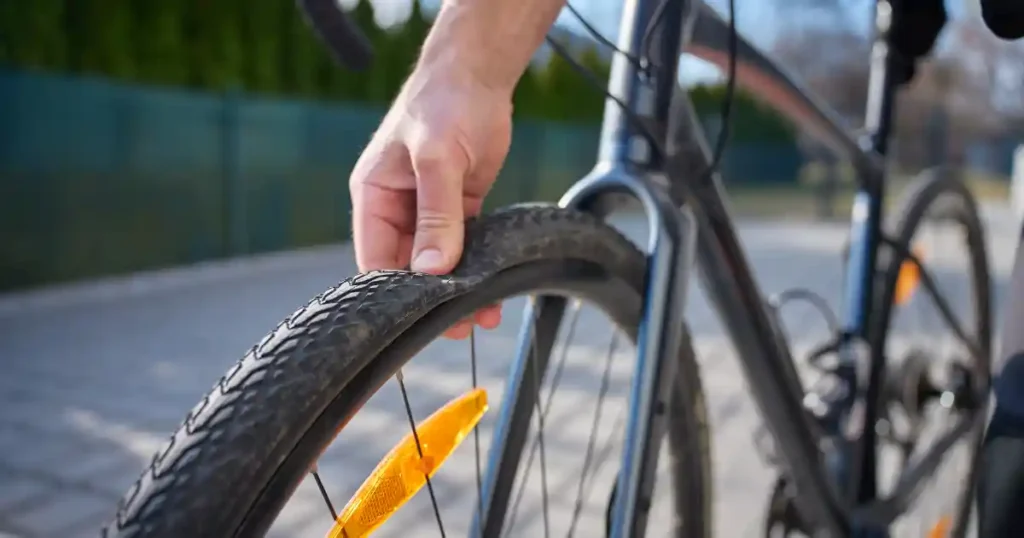
Start with a quick thumb press on both tires. A properly inflated hybrid tire at 55 to 65 PSI should resist firm thumb pressure noticeably but should not feel like a rock. If your thumb compresses the tire more than a few millimeters with moderate force, the tire is likely underinflated. If it feels completely unyielding with no flex at all, it may be overinflated.
Follow that with your pump gauge if anything feels off or if it has been more than a few days since your last ride. Confirm the PSI is within your target range for today’s route and conditions. Make small adjustments as needed. That is the complete check. Simple and fast.
Weekly Maintenance Habit
Once a week, do a full check. Attach your pump, read the actual PSI, and bring both tires to your target pressure. While the pump is out, inspect both tires visually by running them slowly through your hands and looking for cuts, embedded debris, or cracking in the sidewall rubber.
Early detection of a slow leak, a small cut, or sidewall wear saves you from an unexpected flat mid-ride. Most visible damage is detectable before it becomes a ride-ending problem. Make the weekly check a consistent part of your preparation and it becomes automatic within a few weeks.
Find Your Personal Sweet Spot
No pressure number works perfectly for every rider, every tire, and every road. The goal is finding what works best for your specific combination.
Practical Takeaways
Start with the recommended range for your tire width and body weight. Set the rear tire 3 to 5 PSI higher than the front. Adjust in small increments of 3 to 5 PSI per session and test on your familiar route. Go lower for rougher surfaces, higher for smooth city roads. Check pressure before every ride. Inflate in conditions close to your riding temperature.
Stick with this process for two to three weeks and you will know your personal sweet spot with enough confidence to set it consistently without constant retesting. That knowledge transfers to every future tire swap, seasonal change, or new route you take on.
Honest Ending (Because It Happens)
Some mornings you check your pressure, nail your target PSI, and the bike feels exactly right from the first pedal stroke. Everything is smooth, responsive, and comfortable. Those rides remind you why getting the small details right matters.
Other mornings you check the same pressure on the same bike and something feels slightly off. Maybe it rained and the road surface is different. Maybe you are tired and more sensitive to every vibration. The temperature dropped overnight more than you expected.
Both happen. Tire pressure is a major variable in your riding experience, but it is not the only one. When a ride feels off despite good pressure, check the other basics before second-guessing your PSI. Most of the time, getting pressure right means the rest of the variables are smaller problems than they would otherwise be.
Final Recommendation
Getting your tire pressure right is one of the simplest and most impactful things you can do for your hybrid bike. After years of riding and testing different setups across varying roads and conditions, the clearest advice I can offer is this: start with your tire width and body weight to find your PSI range, always run the rear slightly higher than the front, and never confuse the maximum on the sidewall with the optimal pressure. For most hybrid riders, the sweet spot sits comfortably in the 50 to 65 PSI range depending on tire size and terrain.
Check pressure before every ride using a reliable floor pump with a gauge, adjust for weather and surface type, and make small changes until the bike feels balanced between speed and comfort. You do not need expensive tools or complicated calculations. You need consistent attention and a willingness to adjust. Dial in your pressure once and your hybrid rides like a completely different bike.
FAQs
The ideal hybrid bike tire pressure is usually 50–70 PSI. It depends on tire width and rider weight. Check your sidewall for the range and adjust for comfort and control.
Correct hybrid bike tire pressure improves speed, grip, and comfort. Low pressure feels soft but slow. High pressure rolls fast but may feel harsh. Balance is key for smooth rides.
Low hybrid bike tire pressure can cause slow rides and pinch flats. The tire may feel heavy and unstable. It also wears faster, so check pressure often for better cycling safety.
High hybrid bike tire pressure makes the ride hard and bumpy. It reduces grip on rough roads. This can lead to less control, especially on wet or uneven surfaces.
Check your hybrid bike tire pressure at least once a week. Tires lose air over time. Regular checks help keep your ride smooth, safe, and more efficient.
Yes, rider weight affects hybrid bike tire pressure. Heavier riders need more PSI for support. Lighter riders can use less for comfort. Small changes can improve ride feel.
No, adjust hybrid bike tire pressure based on terrain. Use higher PSI for smooth roads and lower PSI for rough paths. This helps improve grip, comfort, and control.

Ehatasamul Alom is a dedicated road hybrid bikes expert. With over 15 years of experience, he helps people find the perfect ride. He began his journey as a bike mechanic. He learned the ins and outs of every bike.
Ehatasamul Alom holds a Master’s degree in Mechanical Engineering from a Brown University (Providence US 02912), where he specialized in material science and bicycle kinematics. His master’s thesis focused on optimizing frame geometry for road hybrid bikes to improve rider comfort and efficiency.
Ehatasamul has an extensive professional background. He spent 10 years (2010-2020) as a Senior Bike Designer at “Urban Cycles,” a leading bicycle manufacturer. In this role, he led the development of several award-winning road hybrid bikes, which are known for their durability and performance. He later served (2020-2024) as the Head of Product Development at “Gear Up,” a company specializing in high-end cycling components. There, he developed innovative parts and accessories specifically for road hybrid bikes.
Over the years, Ehatasamul has become an authority on Roadhybridbikes. He understands their design and function. His work focuses on making bikes easy to use. Ehatasamul believes everyone should enjoy cycling. He writes guides that are simple to read. His passion for road hybrid bikes is clear. His goal is to share his knowledge with everyone. He wants to see more people on two wheels. His advice is always practical and easy to follow.
- Ehatasamul Alom

- Ehatasamul Alom
- Ehatasamul Alom
- Ehatasamul Alom